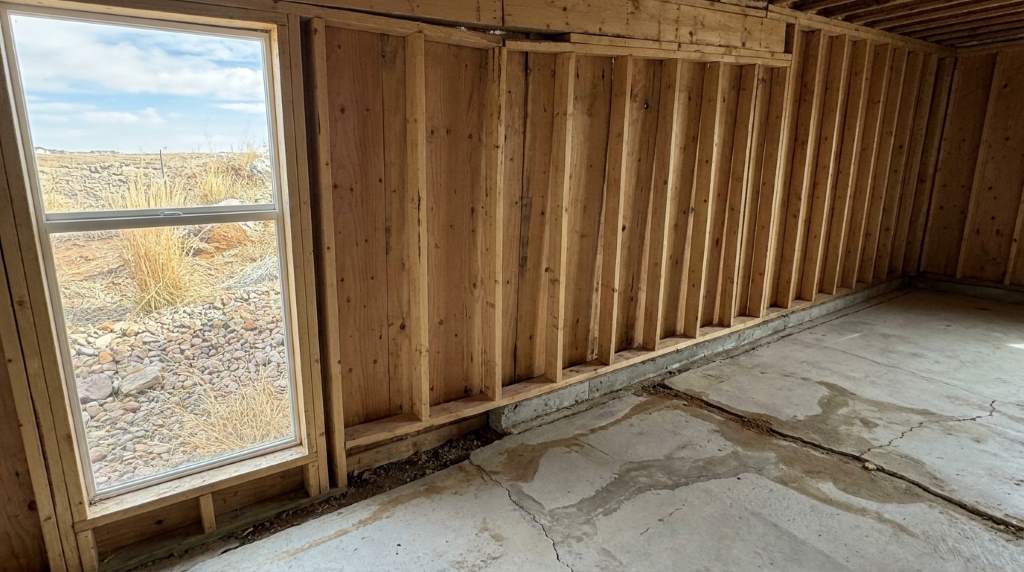
Basement stud walls wobble mainly because framing lacks proper anchoring, bracing, or a stable connection to the slab. Denver’s freeze-thaw cycles and variable soils can also expose weak framing connections over time. Denver averages its first freeze around October 7 and last freeze around May 5. The local frost line reaches 36 inches, making foundation movement an important consideration. Even drilling holes for concrete anchors requires careful placement.
Key Takeaways
- Wobbly studs usually point toward weak anchoring, poor bracing, or framing movement.
- Concrete floors can shift independently from basement walls and create noticeable framing movement.
- Moisture changes can affect wood framing, fasteners, drywall, and surrounding foundation materials.
- Denver’s freeze-thaw conditions can amplify movement around vulnerable foundation connections.
- Loose bottom plates need inspection before adding more screws or cosmetic finishes.
- Structural cracks or major wall displacement require professional evaluation before repairs begin.
Denver Conditions Can Reveal Weak Basement Framing
Basement framing rarely becomes unstable because of one isolated factor. Instead, several small construction or environmental problems can combine and create noticeable movement.
Denver presents several conditions that can expose weak framing connections. Seasonal temperature changes, soil moisture, and foundation movement can all influence basement assemblies.
Therefore, a wall that felt solid during construction may feel different several years later. The key question involves identifying where the movement actually begins.
Start by Finding the Movement Point
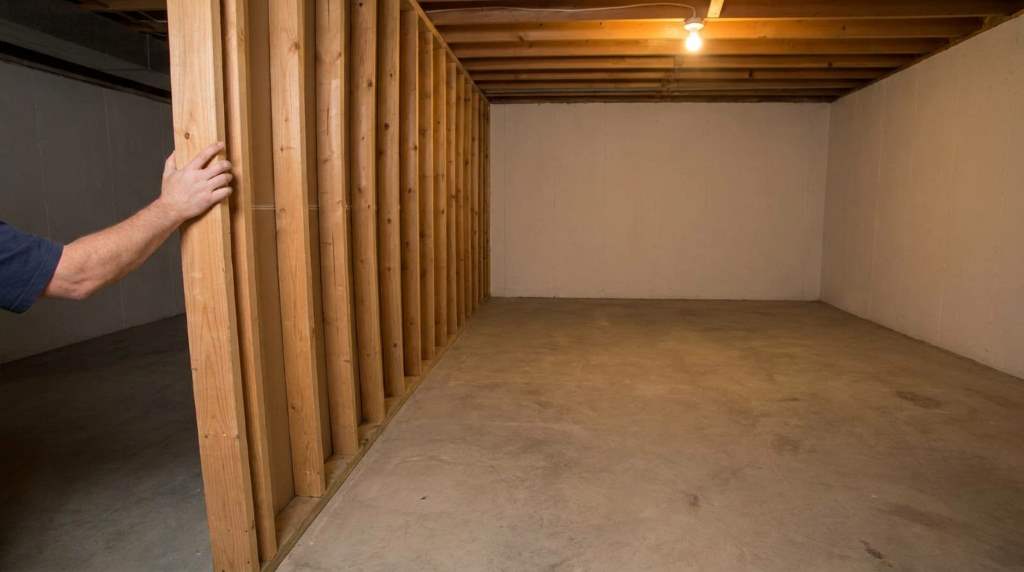
Push the wall gently near the bottom plate, middle studs, and top plate. Notice whether the entire wall moves or only individual studs respond.
If the bottom plate shifts, inspect its connection with the concrete slab. If individual studs move, examine their fasteners and blocking.
Next, check the top connection against floor joists or blocking. A missing connection can let the upper wall flex like a hinged panel.
Finally, inspect drywall seams around corners and doors. Cracks in these areas can reveal movement that framing inspection alone might miss.
Framing Connections Often Cause the Wobble
Basement walls need reliable connections at their bottom, top, corners, and intersections. Weak connections allow small forces to produce surprisingly large movement.
For example, a bottom plate may sit correctly while using too few fasteners. Consequently, the wall can shift sideways when someone pushes against it.
Construction details matter because framing depends on many individual connections. Even a sturdy stud becomes unstable when its surrounding assembly lacks restraint.
Homeowners sometimes focus on adding decorative features before checking structural connections. That approach resembles how metal balustrades in spaces depend on proper attachment.
Common Connection Problems
- Loose bottom-plate fasteners: These allow horizontal movement across the concrete surface.
- Missing top blocking: This permits the wall’s upper edge to flex under pressure.
- Weak corner connections: Poorly connected corners can make entire wall sections feel unstable.
- Insufficient stud fastening: A stud may twist when fasteners fail to restrain it.
- Improper framing gaps: Excessive gaps can reduce contact between connected framing members.
- Damaged fasteners: Corrosion or poor installation can weaken otherwise adequate connections.
Concrete Slabs and Foundations Can Move Differently
A basement stud wall usually sits on or beside a concrete foundation system. Those components do not always experience identical movement.
The concrete slab can settle slightly while foundation walls remain comparatively stable. Conversely, foundation movement can affect nearby framing without significantly shifting the slab.
Moisture changes can further complicate the picture. Soil expands and contracts as water conditions change, especially around susceptible soils.
These changes can produce subtle movement rather than dramatic structural failure. Homeowners may first notice that drywall, trim, or shelving feels loose.
Why Soil Conditions Matter
Denver’s building requirements recognize expansive, compressible, shifting, or questionable soils as conditions requiring additional evaluation.
Expansive soil can change volume when moisture conditions change. That movement can transfer forces toward foundation elements and connected framing.
However, a wobbly stud wall does not automatically indicate foundation failure. The framing connection itself may remain the simplest explanation.
For that reason, inspect the wall before assuming a major foundation problem. Start with fasteners, plates, blocking, and visible gaps.
Moisture Can Turn Small Framing Problems Into Bigger Ones
Basements experience different moisture conditions than rooms above grade. Condensation, seepage, plumbing leaks, and humid air can all affect framing.
Wood can change dimensions when its moisture content changes. Repeated expansion and contraction can gradually loosen connections or create gaps.
Meanwhile, damp conditions can affect metal fasteners and hardware. Rust may reduce fastening performance when corrosion becomes significant.
Dust also reveals neglected maintenance because particles collect around shelves, trim, and framing gaps. Understanding how dust settles on things can help during visual inspections.
Look for These Moisture Clues
- Darkened wood: Discoloration may indicate previous or continuing moisture exposure.
- Musty odors: Persistent odors can suggest hidden moisture or poor basement ventilation.
- Rusty hardware: Corrosion may weaken fasteners and indicate prolonged moisture exposure.
- Peeling finishes: Damaged paint or coatings can reveal moisture migration through nearby materials.
- Soft wood: Spongy framing requires prompt inspection because decay can reduce structural capacity.
- Efflorescence: White mineral deposits can indicate moisture movement through masonry or concrete.
Installation Shortcuts Can Leave Walls Under-Braced
Some basement walls wobble because installers prioritize speed over complete framing restraint. A wall can look finished while still lacking important structural connections.
Builders may also adapt framing around ducts, pipes, windows, or uneven foundations. Those adjustments can accidentally remove blocking or reduce fastening opportunities.
Furthermore, finishing work can hide framing defects. Drywall may conceal loose plates, missing fasteners, or oversized framing gaps.
That explains why treated overconfidence in builders can become costly. Good workmanship depends on verification rather than assumptions.
Signs of Incomplete Bracing
Look behind accessible areas before opening finished walls unnecessarily. Mechanical rooms, unfinished corners, and utility spaces often provide useful inspection points.
Check whether studs connect firmly with plates and blocking. Also inspect corners where multiple framing members should work together.
Pay special attention to long uninterrupted walls. Longer wall sections generally need more restraint to resist lateral movement.
If the wall supports shelving, cabinets, or heavy finishes, movement becomes more noticeable. Those loads can magnify small framing deficiencies.
How to Diagnose a Wobbly Stud Wall
A systematic inspection prevents unnecessary repairs. Start with the simplest explanation and progress toward more complex causes.
Step 1: Test the Wall Carefully
Apply light hand pressure at several heights. Do not use excessive force because damaged framing can fail unexpectedly.
Mark the locations where movement feels strongest. Compare those points with corners, openings, and visible fasteners.
Step 2: Inspect the Bottom Plate
Look for gaps between the bottom plate and concrete. Also check whether fasteners appear present, tight, and properly positioned.
Never assume visible screws provide adequate structural attachment. Fastener type, embedment, spacing, and substrate condition all matter.
Step 3: Inspect the Top Connection
Examine the connection between the wall and overhead framing. Missing blocking can allow considerable lateral movement.
Look for gaps between the top plate and floor framing. Shims or blocking may provide necessary contact where appropriate.
Step 4: Check Individual Studs
Push each accessible stud gently and compare its movement with neighboring studs. One loose stud usually indicates a localized fastening problem.
Several moving studs suggest a broader framing issue. At that point, inspect plates, corners, blocking, and wall alignment.
Step 5: Check the Foundation Area
Inspect nearby concrete for significant cracks, displacement, or moisture intrusion. Document unusual changes with photographs and measurements.
Track cracks over time rather than relying on memory. Consistent measurements provide better evidence of progressive movement.
When You Can Repair the Wall Yourself
Minor nonstructural movement may respond to straightforward framing repairs. However, the correct repair depends on the actual failure point.
A loose non-load-bearing stud may need proper fastening or blocking. A poorly attached bottom plate may require an appropriate concrete fastening system.
Before drilling into concrete, identify utilities and confirm the fastening method. Avoid placing anchors where electrical or plumbing systems may run.
Also consider whether the wall requires special fireblocking or moisture-control details. Repairs should preserve existing code-required assemblies.
Useful DIY Checks
- Measure wall movement: Record movement at the bottom, middle, and top.
- Inspect fasteners: Look for missing, loose, damaged, or inappropriate fasteners.
- Check framing alignment: Compare the wall against nearby fixed reference points.
- Inspect moisture: Search for leaks, condensation, staining, and damp materials.
- Document cracks: Photograph cracks from consistent angles and measure their widths.
- Check accessibility: Use unfinished areas to inspect hidden connections before removing drywall.
When a Professional Should Inspect the Basement
Professional evaluation becomes important when movement exceeds a simple framing connection problem. Significant foundation displacement deserves particular attention.
Call a qualified professional when walls visibly lean, foundations crack extensively, or movement continues despite framing repairs.
Likewise, seek help when doors suddenly bind or floors develop noticeable changes. Multiple symptoms occurring together deserve more careful investigation.
Professionals can distinguish framing movement from foundation movement using measurements and structural assessment. That distinction prevents expensive repairs aimed at the wrong component.
Red Flags You Should Not Ignore
- Rapidly increasing wall movement: Sudden changes can indicate an active problem.
- Large foundation cracks: Significant cracking requires evaluation before cosmetic repairs.
- Visible wall displacement: Leaning walls can indicate more than loose framing.
- Water entering repeatedly: Persistent moisture can damage framing and surrounding materials.
- Severely corroded anchors: Corrosion may compromise critical structural connections.
- Multiple connected symptoms: Several changes together can indicate a broader building movement issue.
How Denver Homeowners Can Prevent Future Wall Movement
Prevention begins with controlling moisture and maintaining reliable framing connections. Regular inspection can catch small problems before finishes conceal them.
Keep gutters and downspouts functioning properly around the property. Direct roof runoff away from foundation areas whenever site conditions allow.
Maintain stable indoor humidity and repair plumbing leaks quickly. Avoid allowing repeated wetting and drying around basement framing.
During remodeling, avoid removing blocking without replacing its structural function. Every modification should preserve the wall’s intended bracing system.
Finally, photograph important framing connections before covering them. Future owners and contractors can then understand how the wall was constructed.
A Practical Repair Decision Tree
If only one stud moves, inspect that stud’s fasteners first. If the entire wall moves, inspect the plates and major connections.
If the bottom plate moves, investigate its concrete attachment. If the top moves, examine blocking and overhead framing.
If the foundation also shows movement, stop treating the issue as simple carpentry. A structural professional should evaluate the complete assembly.
This approach saves time because each symptom points toward a different diagnostic path. It also reduces the risk of covering an unresolved structural problem.
Conclusion
Basement stud walls wobble in Denver primarily because weak framing connections allow movement to accumulate. Local soil behavior, moisture changes, and seasonal conditions can make those weaknesses more noticeable.
Start with the bottom plate, top connection, individual studs, moisture clues, and foundation condition. Then repair the actual source instead of simply stiffening the visible symptom.
If you notice significant movement, leaning, major cracks, or recurring moisture, arrange a professional inspection. A targeted diagnosis can protect your basement, finishes, and future renovation budget.
FAQs
Why does my basement wall shake when I push it?
A loose bottom plate, missing blocking, or inadequate stud fastening usually causes noticeable movement.
Can Denver soil cause basement stud walls to wobble?
Yes, changing soil conditions can contribute to foundation movement that affects connected basement framing.
Should I add more screws to stop a wobbly wall?
Only after identifying the movement source and selecting fasteners suitable for the framing and concrete conditions.
Is a wobbly basement wall always a foundation problem?
No, many wobbly walls have localized framing or fastening problems that do not involve foundation failure.
When should I call a structural professional?
Call one when movement progresses, walls lean, significant cracks appear, or several structural symptoms occur together.